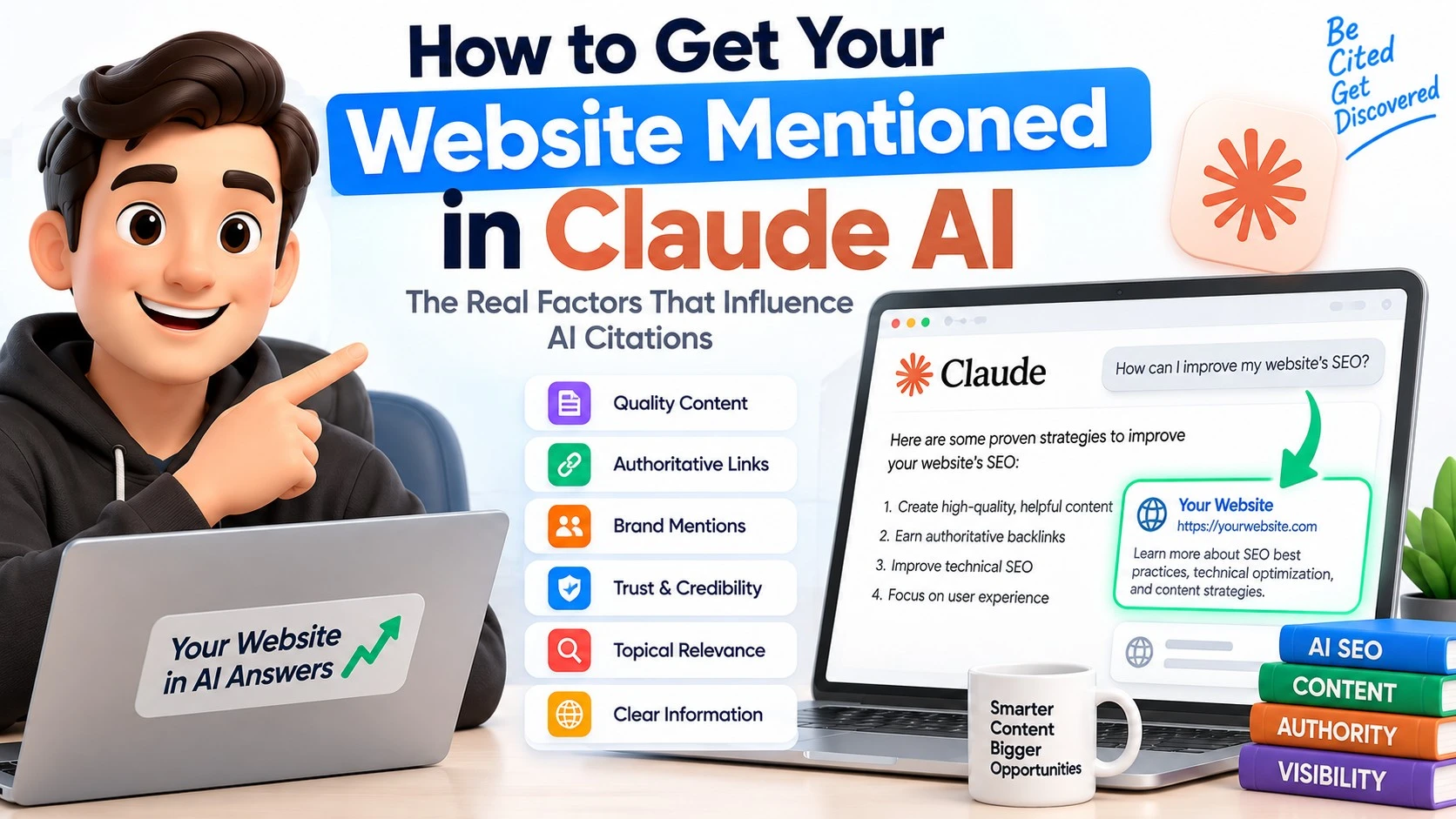
Artificial intelligence is changing how people discover brands online. Instead of clicking through multiple search results, users are increasingly asking AI assistants like Claude AI for recommendations, research, and answers. When Claude provides a response, it often cites sources that it considers trustworthy, authoritative, and relevant.
The question many businesses are now asking is simple: How do I get my website mentioned in Claude AI?
At Webastr, we have analyzed how AI platforms discover, understand, and reference websites. While there is no official "Claude ranking algorithm," there are clear patterns that influence which websites get cited and which are ignored.
Claude AI Doesn't Rank Websites Like Google
One of the biggest misconceptions is treating Claude like a traditional search engine.
Google ranks pages primarily through backlinks, keywords, and hundreds of ranking signals. Claude, however, focuses on understanding information and selecting sources that best answer a user's question.
For example, if someone asks:
"Who offers the best local SEO services for small businesses?"
Claude may not choose the page ranking #1 on Google. Instead, it may reference a website that provides the clearest explanation, strongest evidence, and most relevant expertise.
This means businesses must optimize for understanding, not just rankings.
Build Entity Authority Around Your Brand
Claude AI is more likely to recognize brands that appear consistently across the web.
Your business name should be associated with specific topics and services.
For example, Webastr should consistently appear alongside terms such as:
SEO Services
Technical SEO
AI SEO
Local SEO
Website Optimization
Digital Marketing
When your brand is mentioned on multiple trusted websites, directories, blogs, social profiles, and industry platforms, AI systems begin connecting those mentions into a recognized entity.
The stronger the entity association, the higher the chance Claude will understand who you are and what you specialize in.
Create Content That Answers Complete Questions
Claude is designed to answer questions.
Many websites create content targeting short keywords such as:
SEO Services
Technical SEO
Local SEO
Instead, create pages that answer complete user questions:
How does technical SEO improve rankings?
What are the benefits of local SEO for small businesses?
How much does SEO cost in 2026?
What is AI SEO optimization?
Claude often extracts information from pages that directly answer questions because they match conversational user queries.
Publish Original Insights Instead of Rewritten Content
AI models encounter millions of articles covering the same topics.
If your content simply repeats what already exists online, Claude has little reason to reference it.
Original content performs better because it provides unique value.
Examples include:
Industry case studies
Ranking growth reports
Traffic improvement data
Client success stories
Proprietary frameworks
Research findings
For example, if Webastr publishes a case study showing how a website increased organic traffic by 200%, Claude may reference that data when discussing SEO results.
Strengthen Topical Authority
Claude looks for expertise.
A website with one SEO article is less likely to be trusted than a website with fifty interconnected SEO resources.
Build topic clusters around your niche.
For SEO agencies, create content covering:
Keyword Research
Technical SEO
On-Page SEO
Off-Page SEO
Link Building
Local SEO
AI SEO
Google Search Console
Core Web Vitals
The deeper your content coverage, the more likely Claude will view your website as a reliable source.
Earn Mentions From Authoritative Websites
Claude frequently references information that appears across multiple trusted sources.
This means digital PR and brand mentions are becoming increasingly important.
Focus on obtaining mentions from:
Industry blogs
Business directories
News websites
Guest posts
Podcasts
Professional communities
When Claude sees your brand repeatedly associated with a specific topic, it gains confidence in referencing your website.
Use Structured Information
AI systems prefer content that is easy to extract.
Instead of large blocks of text, use:
Definitions
FAQs
Step-by-step guides
Lists
Tables
Comparison sections
For example:
"What is AI SEO?"
A short definition followed by detailed explanation makes it easier for Claude to quote or summarize your content.
Create AI-Friendly Brand Pages
Many websites focus only on service pages.
Create dedicated pages explaining:
Who you are
What services you offer
Your experience
Your methodology
Client results
Industry expertise
These pages help Claude understand your brand entity and improve the chances of being referenced in AI-generated responses.
Demonstrate Real Expertise
Claude increasingly favors content written by people with genuine experience.
Include:
Author bios
Credentials
Experience details
Client examples
Professional achievements
For example, if Webastr has years of SEO experience and successful client campaigns, showcase those achievements clearly.
Expert-driven content is significantly more likely to be trusted than generic AI-generated articles.
Optimize for AI Citations, Not Just Rankings
The future of SEO is no longer limited to Google rankings.
Businesses should ask:
"Would an AI assistant trust my content enough to cite it?"
To increase your chances of appearing in Claude AI:
Build brand authority
Publish original research
Answer real questions
Create topical depth
Earn authoritative mentions
Strengthen entity recognition
Demonstrate expertise
Conclusion
Appearing in Claude AI requires more than basic SEO. Businesses must focus on building topical authority, creating answer-focused content, strengthening their brand presence, and demonstrating real expertise. By consistently publishing valuable information and establishing credibility within your industry, you can improve your chances of being referenced in Claude AI responses.
At Webastr, we help businesses prepare for the future of AI-driven search through advanced SEO, AI visibility optimization, content strategy, and authority-building solutions. As AI becomes a major source of online discovery, businesses that adapt early will gain a significant competitive advantage.