Google Pay Per Click advertising is a powerful way for businesses to reach potential customers who are actively searching for products and services online. Instead of waiting for organic rankings to generate traffic, businesses can use paid advertising to appear in relevant search results and reach customers at the right stage of their buying journey.
However, successful PPC advertising is not simply about paying for clicks. Businesses need the right keywords, campaign structure, advertisements, landing pages, targeting, conversion tracking, and ongoing optimization to get the most from their advertising budget.
In this guide, we will explain how Google PPC advertising works, what affects its cost, the different types of Google Ads campaigns, common mistakes to avoid, and how professional PPC management can help businesses improve their advertising strategy.
What Is Google Pay Per Click Advertising?
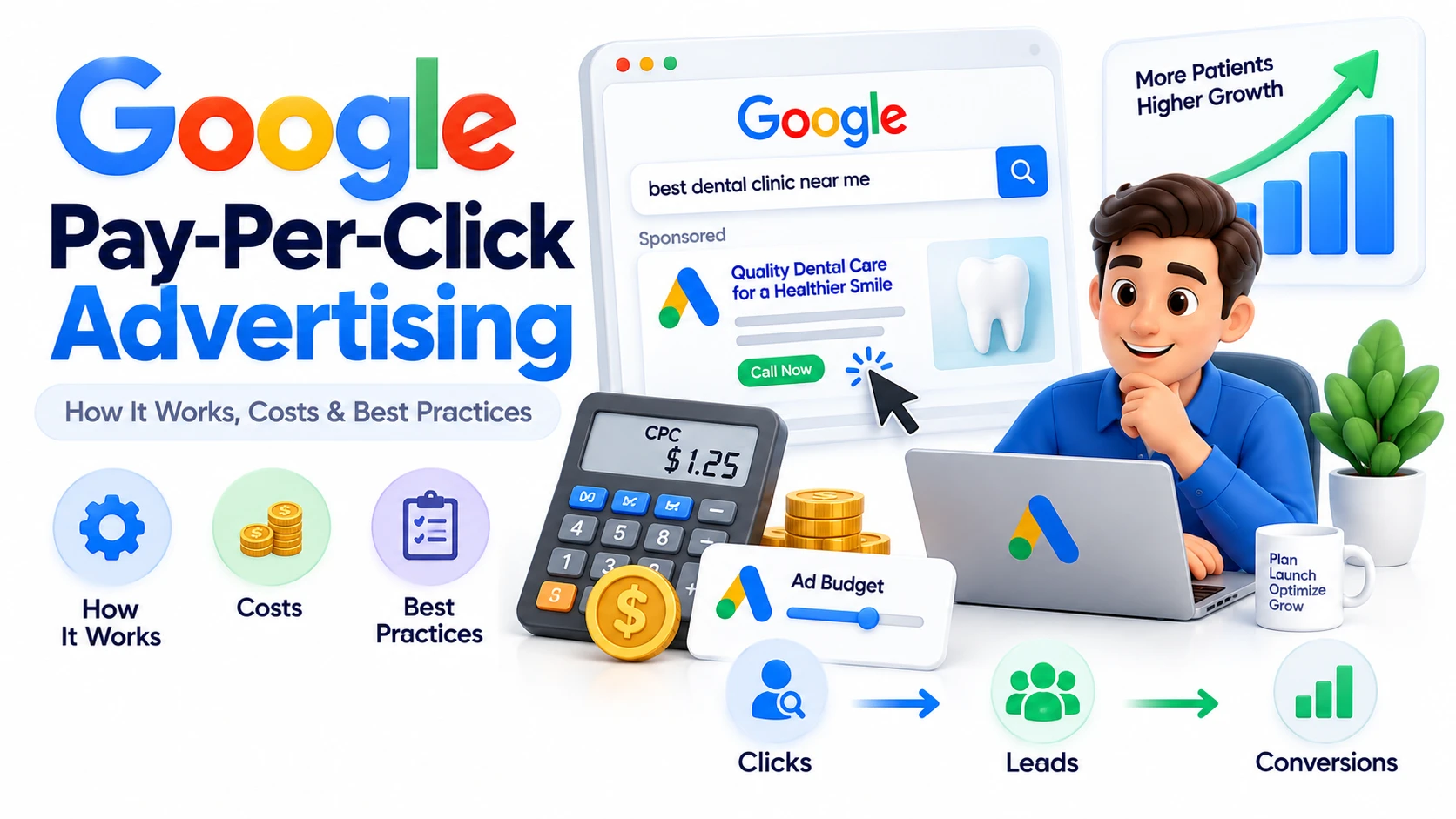
Google Pay Per Click advertising is a form of online advertising where businesses promote their products or services through Google Ads and pay based on user interactions, depending on the campaign and bidding setup.
For example, imagine someone searches Google for:
"website design company"
A website design business can create a Google Ads campaign targeting relevant searches. Its advertisement may appear when the search is relevant to the campaign.
The goal is not simply to generate clicks. A successful PPC campaign should attract people who are genuinely interested in the business and encourage them to take a valuable action, such as submitting a form, making a purchase, calling the business, or requesting a quote.
Google Ads offers different campaign types that can help businesses reach customers across Google's advertising ecosystem.
How Does Google PPC Advertising Work?
Google PPC advertising uses an advertising auction to determine which eligible advertisements can appear when an advertising opportunity occurs.
The process generally works like this:
A customer searches for a product, service, or solution.
Google identifies advertisements that may be relevant to the search.
Eligible advertisements enter the auction.
Google evaluates different factors that influence ad placement.
Relevant advertisements may appear in available ad positions.
The customer clicks an advertisement.
The customer visits the advertiser's landing page.
The business measures whether the visitor completes a valuable action.
This means advertisers cannot simply guarantee the top position by setting the highest possible bid. Ad relevance, quality, landing page experience, competition, search context, and other factors can influence how advertisements perform.
How Much Does Google Pay Per Click Advertising Cost?
There is no fixed price for Google PPC advertising.
The cost of a campaign can vary significantly depending on the industry, competition, keywords, location, targeting, bidding strategy, campaign objectives, and other factors.
Some of the major factors that influence PPC costs include:
Keyword competition
Industry
Geographic targeting
Search intent
Ad relevance
Landing page experience
Bidding strategy
Campaign settings
Competitor activity
Conversion goals
Businesses should therefore avoid choosing their advertising budget based only on the cost of individual keywords.
Instead, the budget should be connected to business goals and customer acquisition economics.
Example of PPC Cost
Suppose a business spends $1,000 on Google Ads and receives 50 qualified enquiries.
The average advertising cost per enquiry would be:
$1,000 ÷ 50 = $20 per enquiry
But the $20 cost alone does not tell you whether the campaign is successful.
If 10 of those enquiries become customers and each customer generates significant revenue, the campaign may be profitable.
This is why PPC performance should be measured using business outcomes rather than clicks alone.
Types of Google PPC Advertising
Google Ads provides different campaign options for businesses with different advertising goals.
| Campaign Type | Common Purpose |
|---|---|
| Search | Reach people actively searching for relevant products and services. |
| Performance Max | Reach potential customers across multiple Google advertising channels based on business goals. |
| Shopping | Promote products with information such as product images, titles and prices. |
| Display | Reach audiences through visual advertisements across relevant placements. |
| Video | Use video advertising to build awareness, engagement and consideration. |
How to Create a Successful Google PPC Campaign
Creating a successful PPC campaign requires a structured approach.
1. Define Your Advertising Goal
Before creating a campaign, decide what you want to achieve.
Your objective could be:
Generate leads
Increase online sales
Generate phone calls
Increase bookings
Promote products
Drive qualified website traffic
Generate quote requests
Increase enquiries
A clear goal helps determine your campaign structure, targeting, landing pages, conversion tracking, and performance metrics.
2. Conduct Keyword Research
Keyword research is an important part of Google Search advertising.
Don't focus only on keywords with high search volume. Consider whether the search reflects genuine interest in your product or service.
For example:
"website design"
is a broad search.
While:
"hire website design company"
may indicate stronger commercial intent.
The best keywords are not necessarily the ones with the highest search volume. They are the ones that are relevant to your business and have the potential to generate valuable actions.
3. Organize Your Campaign Structure
Create a logical campaign structure around closely related products, services, audiences, or goals.
For example:
Campaign: Website Design
Website Design Keywords
Business Website Keywords
Ecommerce Website Keywords
Website Development Keywords
A well-organized structure makes it easier to understand performance and optimize campaigns.
4. Write Relevant Advertisements
Your advertisement should closely match the user's search intent.
A good PPC advertisement should communicate:
What you offer
Why the user should consider your business
A relevant benefit
A clear next step
Avoid exaggerated claims that cannot be supported.
Instead of:
"The World's Best PPC Agency"
use a more specific message such as:
"Google Ads Management for Lead Generation"
when that accurately represents your service.
5. Create a Relevant Landing Page
Getting a click is only the beginning.
After clicking an advertisement, users should reach a page that is closely related to the advertisement they saw.
For example, if your advertisement promotes:
Google Ads Management
the landing page should clearly explain your Google Ads service rather than forcing visitors to search through a generic homepage.
A strong landing page should make it easy for visitors to understand:
What you offer
Who the service is for
Why they should consider it
What makes your business different
What action they should take
6. Set Up Conversion Tracking
Clicks and impressions are useful metrics, but they don't necessarily tell you whether your campaign is generating business.
Track valuable actions such as:
Contact form submissions
Phone calls
Purchases
Bookings
Quote requests
Sign-ups
Enquiries
Conversion tracking helps businesses understand which campaigns and advertising activities are contributing to actual business outcomes.
7. Monitor and Optimize Campaigns
PPC campaigns require ongoing attention.
Regularly review:
Search terms
Click-through rate
Conversion rate
Cost per conversion
Keyword performance
Advertisement performance
Geographic performance
Device performance
Landing page performance
Budget allocation
Use the information from your campaigns to identify opportunities and reduce inefficient spending.
Common Google PPC Advertising Mistakes
Targeting Too Broadly
Broad targeting can attract people who are unlikely to become customers. Make sure your geographic, audience, keyword, and campaign targeting match your actual market.
Ignoring Search Intent
A keyword can have high search volume but still generate poor-quality traffic. Always consider what the user is trying to accomplish when they search for a particular term.
Sending Every Visitor to the Homepage
A generic homepage may not be the best destination for every PPC visitor. A dedicated and relevant landing page can provide a clearer path toward conversion.
Not Tracking Conversions
Without conversion tracking, it becomes difficult to determine whether advertising is producing enquiries, sales, bookings, or other valuable actions.
Focusing Only on Clicks
A large number of clicks does not automatically mean a successful campaign. A campaign with fewer clicks but better-quality leads can be much more valuable.
Ignoring Search Terms
Search-term analysis can reveal irrelevant searches and new opportunities. Regularly reviewing search terms can help businesses improve targeting and reduce unwanted traffic.
Making Constant Changes
Changing campaigns too frequently can make it difficult to determine which strategies are actually working. Campaign changes should be based on meaningful performance data rather than random adjustments.
Google PPC Advertising vs SEO
| Google PPC Advertising | SEO |
|---|---|
| Paid advertising | Organic search visibility |
| Can generate targeted traffic while campaigns are active | Usually requires time to build organic visibility |
| Requires an advertising budget | Does not require payment for every organic click |
| Offers detailed campaign targeting | Focuses on improving organic search visibility |
| Useful for testing offers and paid campaigns | Useful for building long-term organic visibility |
When Should You Hire a Pay Per Click Advertising Agency?
Managing Google Ads can become increasingly complex as campaigns grow.
A business may consider working with a pay per click advertising agency when it needs professional support with:
PPC strategy
Keyword research
Campaign setup
Advertisement creation
Conversion tracking
Landing page recommendations
Budget management
Campaign optimization
Performance reporting
An experienced PPC agency can help create a structured process for planning, launching, measuring, and improving campaigns.
How to Choose Pay Per Click Advertising Services
When comparing pay per click advertising services, don't focus only on the management fee.
Before hiring a PPC provider, consider asking:
How will you structure my campaigns?
How will you research keywords?
How will conversions be tracked?
How often will campaigns be optimized?
What type of reporting will I receive?
How will wasted advertising spend be identified?
How will lead quality be measured?
Who owns the Google Ads account?
How will landing pages be evaluated?
A professional PPC relationship should provide transparency about what is being changed, why changes are being made, and how campaign performance is being measured.
Benefits of Professional Google PPC Management
Professional PPC management can be useful for businesses that do not have enough time or in-house expertise to manage advertising campaigns.
| Benefit | How It Helps |
|---|---|
| Better Campaign Structure | Creates an organized account that is easier to manage, measure and optimize. |
| Relevant Targeting | Helps align keywords, audiences and locations with the business's target customers. |
| Budget Management | Regular analysis can help identify inefficient spending and opportunities for improvement. |
| Conversion Measurement | Helps businesses understand whether advertising is generating meaningful actions. |
| Ongoing Optimization | Campaigns can be adjusted as performance, competition, search behavior and business goals change. |
Conclusion
Google Pay Per Click advertising can be an effective way for businesses to reach potential customers through paid search and other Google advertising opportunities. However, successful PPC is not simply about increasing clicks or spending more money.
A strong campaign combines relevant targeting, clear objectives, effective advertisements, useful landing pages, accurate conversion tracking and continuous optimization.
If managing Google Ads internally becomes difficult, professional pay per click advertising services can provide the strategy, campaign management, measurement and optimization required to build a more structured advertising approach.
Webastr provides digital marketing and PPC solutions designed around business objectives. If you need support with Google Ads campaign setup, PPC management or paid advertising strategy, contact Webastr to discuss your requirements.